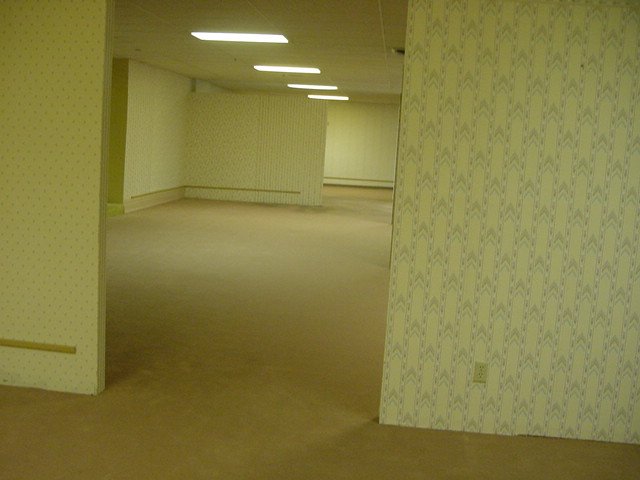
In May 2019, a single photograph posted on 4chan quietly rewired the internet’s sense of unease.
The image is simple. A large, empty room with yellowish walls, stained carpet, and rows of fluorescent lights stretching across the ceiling. No windows. No furniture. No obvious way out. It doesn’t look dangerous — it just looks wrong. Too empty. Too quiet. Too familiar.
That photograph became the foundation of The Backrooms, one of the most influential collaborative horror concepts of the digital age. More importantly for those of us drawn to real places that feel strangely out of step with the world, it also helped crystallise the modern idea of liminal spaces. The moment it went viral was on 12 May 2019: an anonymous user on 4chan’s paranormal board (/x/) started a thread asking people to post “disquieting images that just feel ‘off.’” One of the replies was the now-iconic yellow room.
The following day, another anonymous user replied with the text that would define everything that came after:
“If you’re not careful and you noclip out of reality in the wrong areas, you’ll end up in the Backrooms, where it’s nothing but the stink of old moist carpet, the madness of mono-yellow, the endless background noise of fluorescent lights at maximum hum-buzz, and approximately six hundred million square miles of randomly segmented empty rooms to be trapped in.
God save you if you hear something wandering around nearby, because it sure as hell has heard you.”
In a few sentences, an ordinary renovation photo was transformed into an entire mythology and an infinite, liminal dimension you could fall into by accident. The idea spread rapidly. People began inventing levels, entities, survival rules, and eventually full video series and games. But the emotional core remained the same as the original image: the quiet horror of a space that feels both familiar and completely abandoned by reality.
Where the Photo Actually Came From:
For years the origin of the image remained unknown, which only deepened its power.
In May 2024, a small group of internet researchers finally traced it via the Wayback Machine: the photograph was taken on 12 June 2002 with a Sony Cyber-shot camera inside a building at: 807 Oregon Street in Oshkosh, Wisconsin
At the time, the space was a former furniture store being renovated for a new tenant, a HobbyTown store that planned to turn part of the building into an indoor RC car racetrack called Revolution Raceway. The photo was uploaded to the store’s renovation blog on 2 March 2003. It was simply labelled as a view of “the East (Oval) room” with another angle of the room posted alongside it.

No one involved could have imagined that this casual documentation of a renovation, would one day become one of the most recognisable images on the internet. Ironically, the room that launched a global fascination with liminal spaces was, quite literally, a back room.
Why This Image Resonated So Deeply:
The original Backrooms photo works because it is not dramatic. It is not ruined or overgrown. It’s not theatrical. It is just empty in a way that feels slightly wrong, wallpapered and carpeted in a way that feels slightly familiar. That quality is the essence of liminal spaces. These are places that exist between states, between use and abandonment, between public and private, between the ordinary world and something removed it.
Empty shopping malls after closing time. Hotel corridors at 3 a.m. Underpasses, waiting rooms, and office floors that seem to go on longer than they should. The Backrooms photo did not invent this feeling, but it gave it a perfect visual shorthand. Suddenly people had a shared reference point for that specific atmosphere of soft fluorescent light, muted colour, and quiet dislocation. What makes the story especially interesting for those of us who seek out real liminal locations is how closely the original image matches places that actually exist. The yellow walls, the carpet, the endless-feeling fluorescent grid, these are not pure fiction. They are exaggerated versions of spaces many of us have walked through without fully noticing. The Backrooms mythology took that quiet wrongness and sense of discomforting comfort and stretched it into infinity. But the feeling itself can still be found in the real world: in abandoned malls, empty airports at night, hotels, and even some religious or institutional buildings.
The original photograph remains powerful precisely because it sits on the edge between documentation and dream. It is a real room, photographed for a completely mundane reason, that somehow manages to feel like it was stolen from our memory banks.
And that – more than any invented monster or video game level system, is why it continues to both haunt and fascinate people.