The dead are usually put somewhere that ends the story: a hole in the ground.
But these six locations do the opposite. In their own way, they keep the dead alive and merely let the living pass through.
A flooded crypt beneath an ancient church, a village where hundreds of life-sized figures sit waiting for buses that no longer come, tombs that look like they belong a child’s storybook; these places aren’t abandoned, nor are they all full of skeletons. Yet, they possess a strange quality that makes them feel unfinished, and suspended between the worlds of the living and the dead.
Eklutna Cemetery, Alaska

Outside Anchorage, Alaska, sits one of the most unusual cemeteries in North America: Eklutna Cemetery.
It is famous for its collection of brightly painted spirit houses – tiny wooden structures built over graves. More than 100 of these miniature houses can be found among the clearing in the trees, each with its own unique colors, shape, and decorations.
The cemetery reflects the meeting of Dena’ina Athabascan (native) and Russian Orthodox traditions. Traditionally, the Dena’ina cremated their dead and used spirit houses as places associated with the deceased. Following the arrival of Russian Orthodox missionaries, burial became customary, while the spirit-house tradition continued.
The result is something that feels almost like a miniature village, built by fairies or children.
This is what makes Eklutna so profoundly liminal. The houses are built for people who are no longer there, yet they give the dead a physical presence within the landscape. They look almost as though tiny inhabitants have simply stepped away and left their homes behind.
Yet, the cemetery isn’t abandoned, it remains an active burial ground. It is a living place filled with reminders of people who have passed beyond it.
The Flooded Crypt of San Zaccaria, Italy

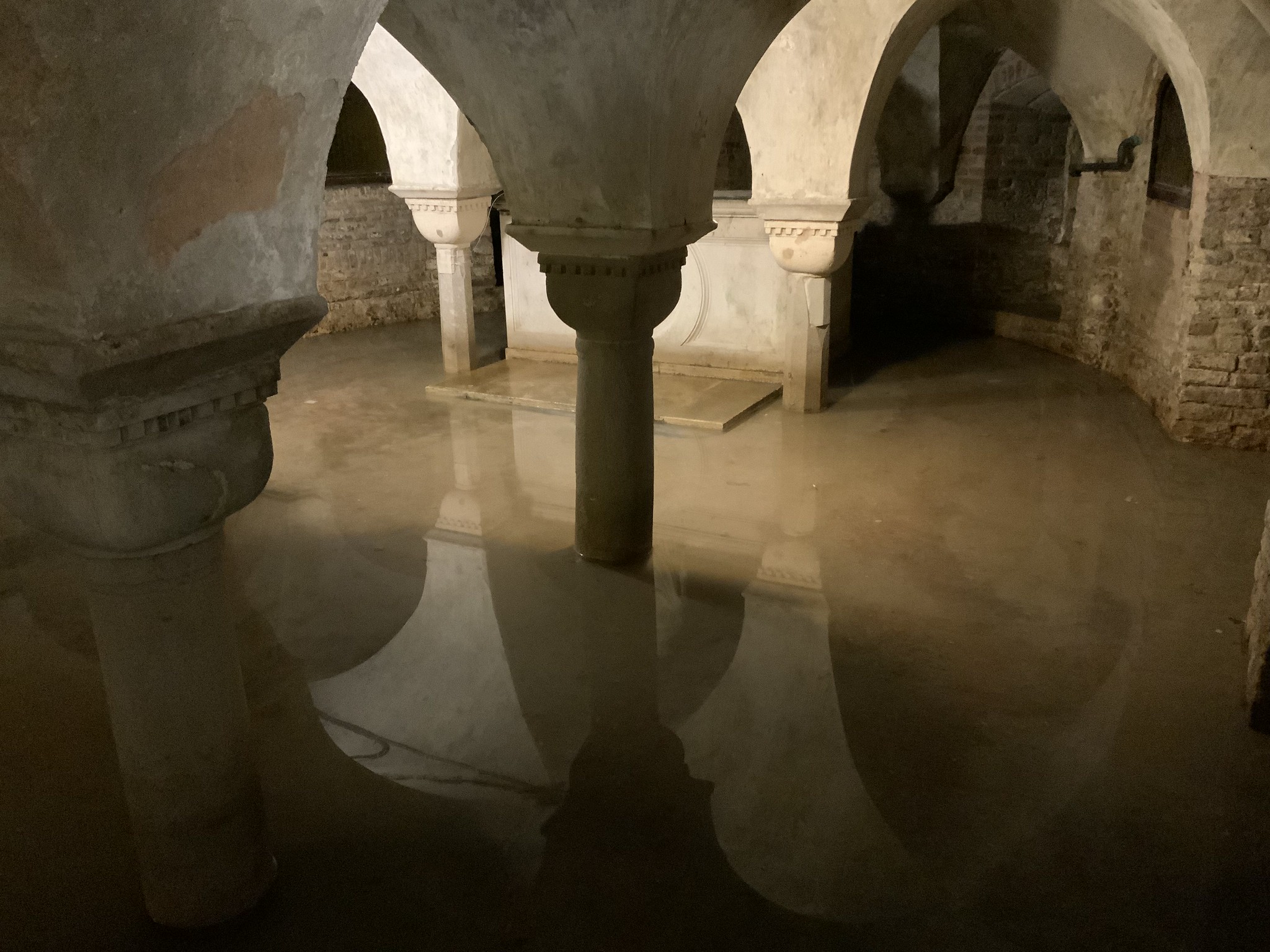
Beneath the Church of San Zaccaria in Venice, lies one of the city’s most surreal spaces: an ancient crypt that spends much of the year partially submerged in water.
The crypt dates back to the early tenth century and is the surviving underground section of an earlier church.
It contains columns, vaulted spaces and historic burials, but Venice’s relationship with water has transformed it into something that feels almost otherworldly. The crypt is flooded for a significant part of the year because of the city’s tides. Standing in the space and looking across the water, it is difficult to tell whether you’re looking at a crypt, or the original blueprint for a Backrooms swimming pool.
It is a space that was designed for the dead, supposed to be sealed away beneath the earth; yet it has become an attraction, admired by the living.
Hill of Crosses (Kryžių kalnas), Lithuania
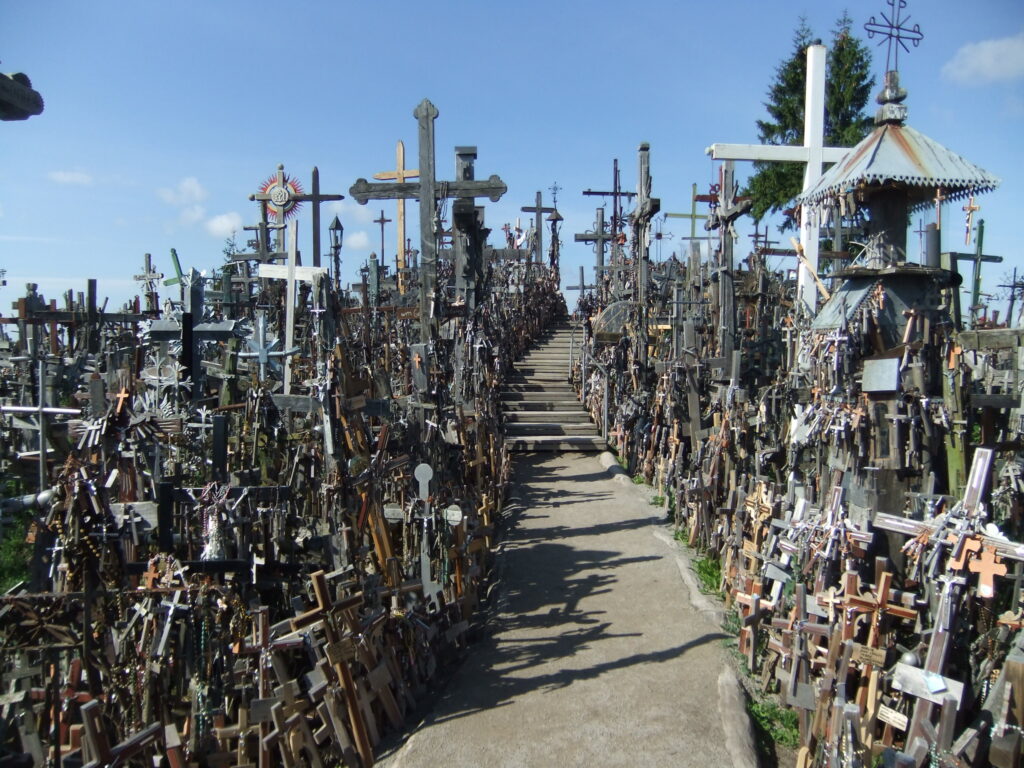
On a small hill in Lithuania stands one of the strangest religious landscapes in Europe.
The Hill of Crosses is covered with a seemingly endless number of crosses, rosaries and religious objects. Lithuania’s tourism authority describes the site as containing well over 200,000.
The origins of the tradition are uncertain, but crosses became associated with remembrance of those who died during uprisings against Russian rule. The hill subsequently developed into a powerful symbol of Lithuanian faith, resistance and remembrance. Soviet authorities repeatedly attempted to destroy it, yet crosses continued to return. Today, the result is extraordinary and surreal. There isn’t a conventional cemetery here. Instead, thousands upon thousands of crosses overlap one another, filling the landscape until it becomes difficult to see where one ends and another begins. It feels less like a single monument and more like a physical accumulation of memory.
Every cross represents something, a person, a prayer, a loss, a hope; with most of them remaining anonymous.
The Skull Chapel (Kaplica Czaszek), Poland


Hidden in the small Polish district of Czermna is a tiny Baroque chapel with an extraordinarily macabre interior.
Known as the Skull Chapel, its walls and ceiling are decorated with approximately 3,000 human skulls and bones, whilst thousands more remains are buried beneath the floor.
The chapel was created in the late eighteenth century by local priest Wacław Tomaszek, who collected the remains of people killed during wars and epidemics, including victims of the Thirty Years’ War and the Silesian Wars.
Human remains are normally hidden beneath the ground, separated from the world of the living. Here, that boundary has been deliberately removed. Skulls look back at you from the walls, bones form patterns that almost appear to be digitally rendered. The dead become part of the architecture itself, and remind one of their own mortality.
And that is what makes it so liminal: rather than simply containing death, the building has been constructed around it. You could be forgiven for thinking you have woken up inside a horrorcore video game.
La Recoleta Cemetery, Argentina
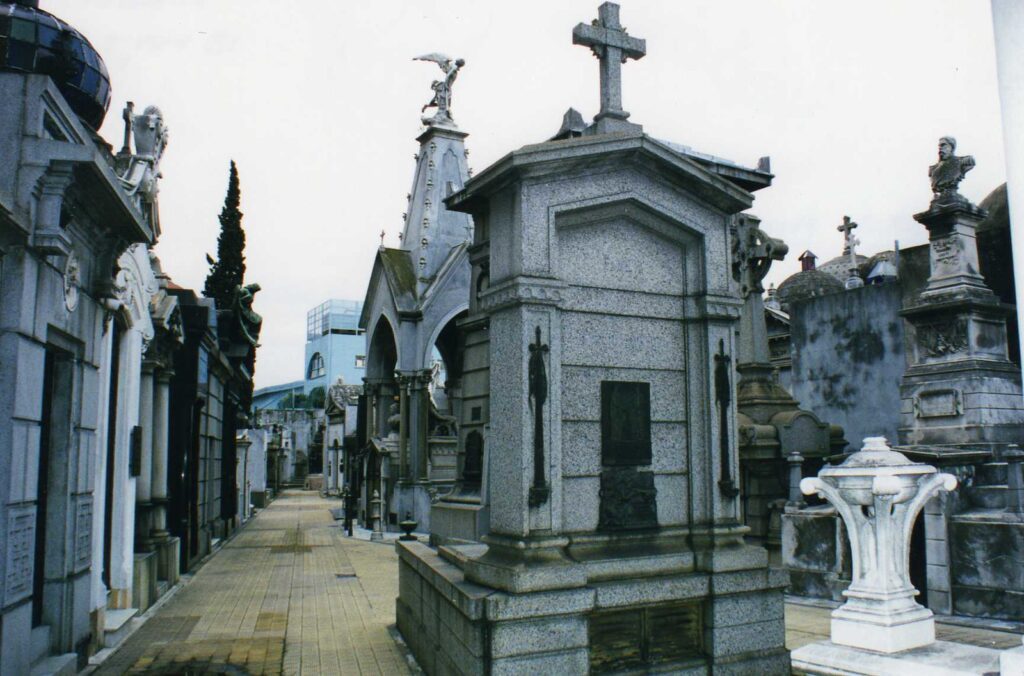
At first glance, La Recoleta Cemetery in Buenos Aires might seem like a beautiful historic cemetery rather than a liminal space. But walk through its narrow streets and the distinction between cemetery and city begins to disappear.
Founded as Buenos Aires’ first public cemetery in 1822, La Recoleta contains thousands of elaborate mausoleums and vaults belonging to some of Argentina’s most prominent figures.
The cemetery contains more than 4,500 vaults, many designed like miniature buildings. There are sculptures, marble statues, elaborate doorways, columns and even mausoleums inspired by ancient architectural styles.
Instead of looking like a traditional graveyard, La Recoleta resembles a silent city of the dead.
There are streets, doorways, buildings, statues standing like inhabitants, and real life cats waiting to greet you and lead you on a side quest.
The effect is deeply uncanny because it mirrors the architecture of the living world so closely. You can wander through its maze-like paths almost as though you are walking through a deserted neighbourhood, except every building is a final resting place. La Recoleta is a city designed for people who can no longer leave it.
Catacombe dei Cappuccini, Sicily
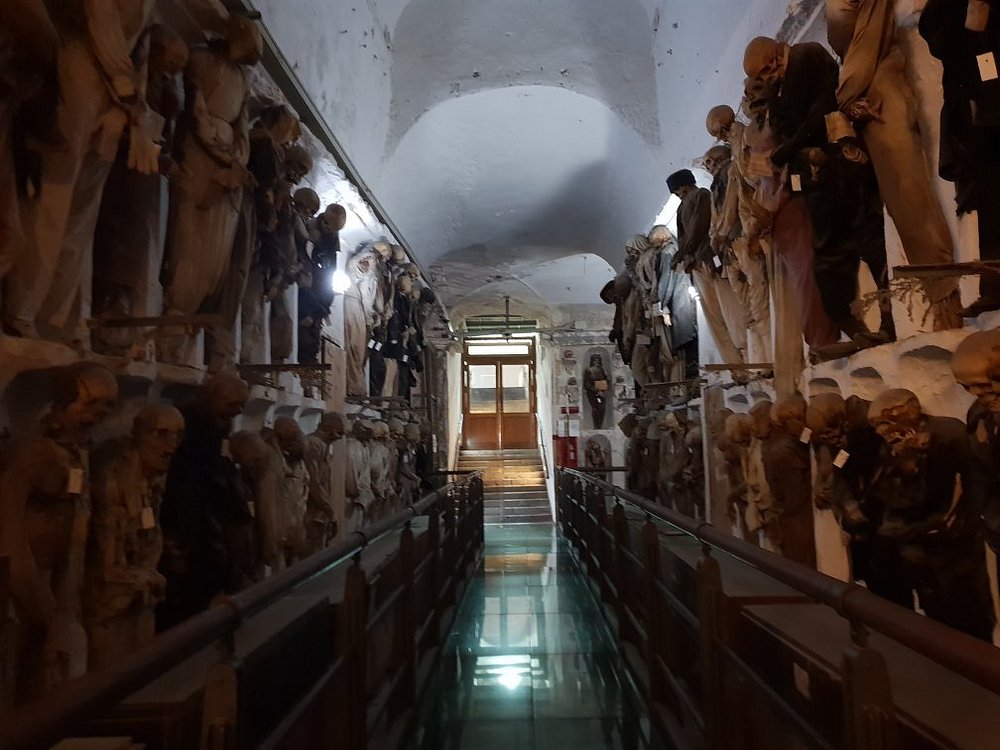
Few places blur the boundary between the living and the dead quite like the Catacombe dei Cappuccini in Palermo.
The underground cemetery began as a burial place for Capuchin friars. In the late sixteenth century, monks discovered that dozens of bodies had naturally mummified, and the decision was made to preserve and display them rather than bury them again. Over the following centuries, thousands of people were placed within the catacombs. The mummies were arranged throughout corridors according to categories including profession, sex and social status.
The result is an underground world where the dead appear to be dressed and waiting. But for what, no on knows. Many are dressed in the clothes they wore during life. And there is something particularly unsettling about the way the catacombs preserve not only the bodies, but the identities of the people themselves. Some of which still maintain very obvious facial expression and personality.
Death has not erased them, instead, it has frozen them in place and left them at the threshold between living and dead.
Chichicastenango (ChiChi Cemetery), Guatemala

High on a hillside overlooking Chichicastenango in Guatemala, is a cemetery unlike almost any other.
Sometimes called Chichi Cemetery, is is filled with brightly coloured above-ground tombs. Turquoise, yellow, pink, white, and other vivid colours cover the hillside; creating something that looks almost like a tiny town built for children.
The colours carry cultural and symbolic meaning. For example, white is associated with fathers, turquoise with mothers and yellow with grandparents and the sun. The cemetery is an important space for the Maya K’iche’ community.
Rather than the muted greys and blacks commonly associated with Western cemeteries, Chichicastenango is vibrant. It looks almost joyful, and breathes life back into the dead.
The tombs themselves are so well kept, they almost resemble small houses, creating the uncanny impression of a neighbourhood where the inhabitants have simply moved somewhere else.
Nagoro Scarecrow Village (Kakashi-no-Sato), Japan
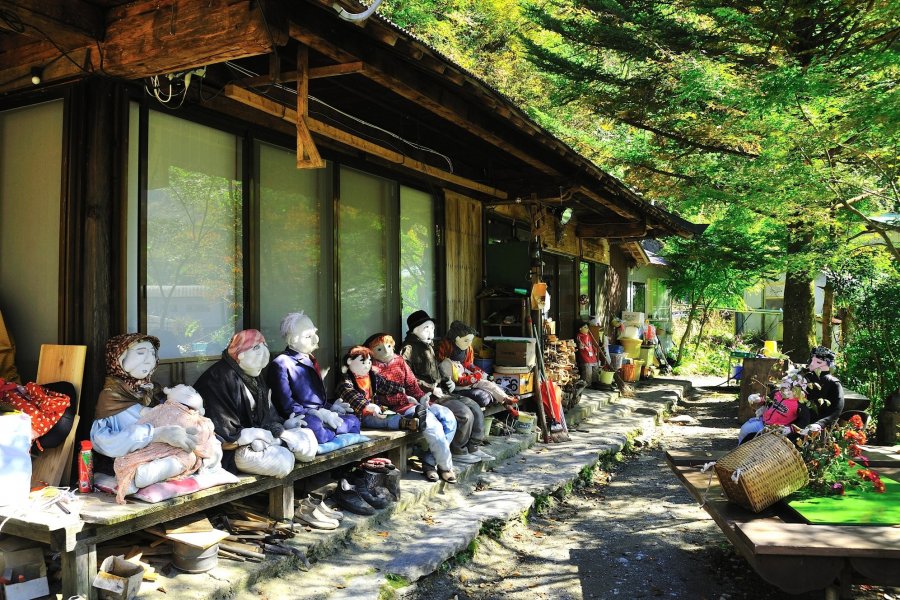
Nagoro is perhaps the strangest location on this list because it isn’t a cemetery, or a regular ‘place of the dead’ at all.
Deep in the Iya Valley of Shikoku, Japan, the remote village of Nagoro has experienced dramatic population decline. As residents died or moved away, the village became increasingly empty.
Artist Tsukimi Ayano, who returned to her childhood village, began creating life-sized scarecrow figures known as kakashi. Many were based on former residents and were positioned around the village: sitting at bus stops, working in fields, and even sitting inside the abandoned school. Today, hundreds of these figures can be found throughout Nagoro alongside only a small number of living residents.
And this is where Nagoro becomes profoundly liminal. If not, the most liminal location on the list.
At first, from a distance, you might mistake the figures for living people. But after a while, you will notice nobody moves. Nobody speaks. Nobody is coming home.
The village has effectively been repopulated by memories of people who are no longer there.
Nagoro therefore exists in an unusual state between an inhabited village and a ghost town. It isn’t truly abandoned, but much of the human activity that once defined it has be replaced by ‘doll’ versions of the original humans.
They are not ghosts, but they create the same unsettling sensation: the feeling that someone should be there, even though they aren’t.
What connects all of these places is not simply that they contain graves, bones or reminders of death. It is the way they distort the boundary between the world of the living and the world of the dead.
They remind us that the boundary between here and there, past and present, presence and absence isn’t always as solid as we imagine. And that death isn’t very far away at all.
If any of these locations speak to you, you can find fuller details, practical information, and more atmospheric notes on their individual listing pages. If you have visited any of these locations, or know of any other deadly, creepy, horrorcore locations, I’d love to hear about it! Let me know via either the Contact or Add a Location form.